

The Athena Health Integration That Adds Preventive Intelligence Without Switching Your EMR
Key takeaways
- “EHR integration” usually conjures a migration: a new system, retraining, and weeks where the practice runs slower. The Athena Health integration works differently.
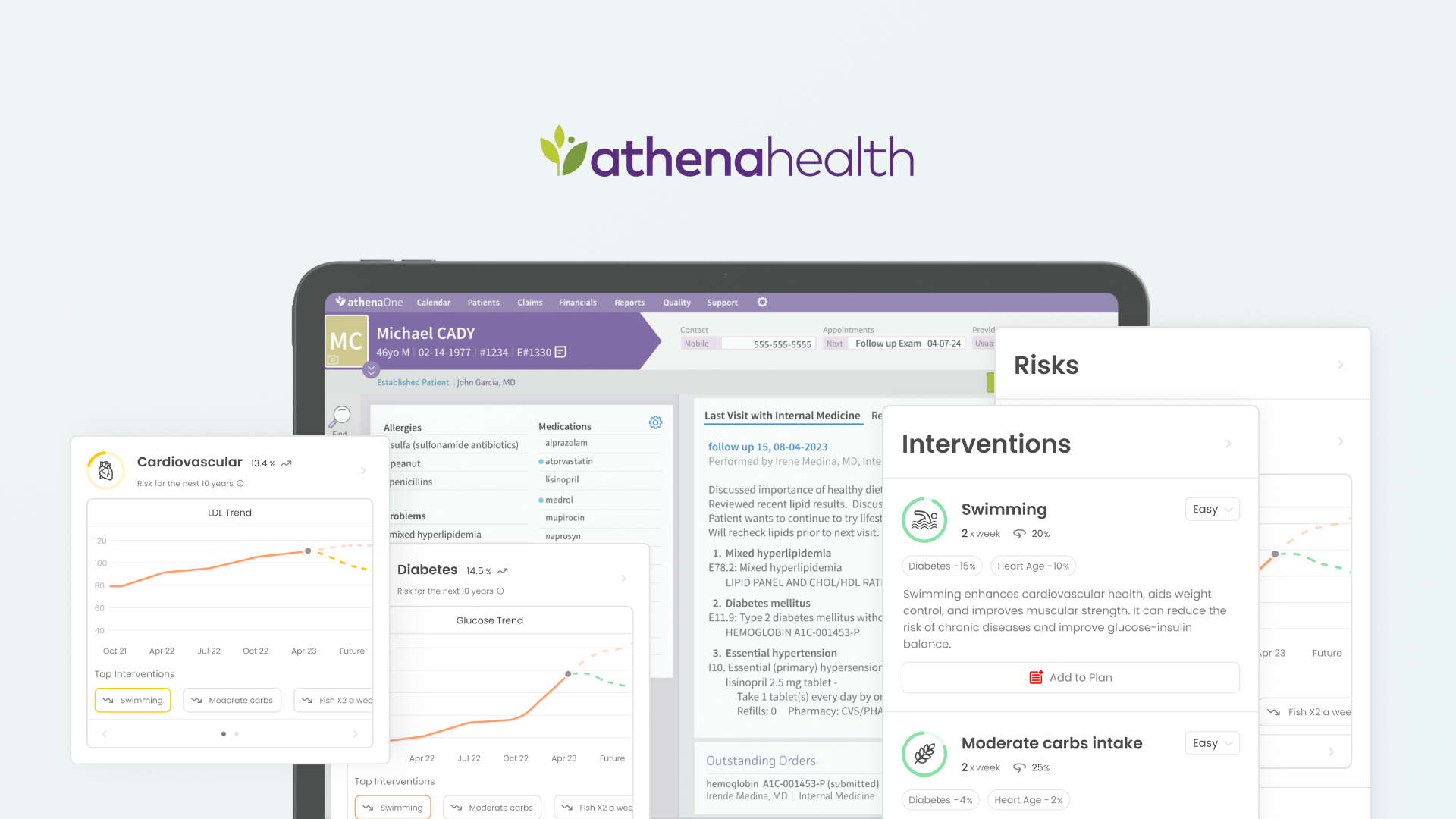
- Longevity AI reads the patient data already flowing through Athena Health and adds a preventive layer on top, while the team keeps charting in Athena Health the same way.
- Most of the signal that forecasts cardiovascular and metabolic risk is already sitting in the records a practice collects in Athena Health.
- Florence reads that data as it arrives, tracks each patient against their own baseline, and drafts the summaries and care plans. Clinicians review, edit, and approve every output inside Longevity AI.
- For a growing practice on Athena Health, this turns existing data into earlier action and more revenue per patient, without adding headcount for every new panel.
For most practice owners, “EHR integration” arrives with a knot in the stomach. It tends to mean a migration: a new system to license, a staff retraining schedule, a data-transfer project, and a stretch of weeks where the practice runs slower while everyone relearns where the buttons are. The cost of switching is real enough that many clinics decide the preventive capability they want is not worth the disruption to get it.
The Athena Health integration was built to avoid that trade-off. It connects to the Athena Health EMR a practice already runs, reads the patient data flowing through it, and adds a preventive layer on top, while the team keeps charting in Athena Health the same way they did yesterday.
This article is about what that integration is, how the read-only connection works, and what it means for a practice that wants earlier, preventive action without changing its system of record.
What the Athena Health integration is
When a vendor says their product “integrates with your EHR,” it can mean very different things. Sometimes it means a full migration to a new platform. In other cases it means a connection that writes data back into the chart, which raises its own questions about what is changing the record and who approved it. Both carry weight: new logins, new workflows, governance review, and the risk that the system of record now has more hands in it.
The Athena Health and Longevity AI integration continuously reads new patient records, lab files, and clinical documents from Athena Health as they arrive and brings them into a preventive layer. Florence, our clinical AI companion, does the hours of synthesis on top of that incoming data, while the clinician can review and approve every output. That separation is the whole reason a practice can add preventive capability without absorbing a switching cost.
The preventive signal is already in your Athena Health records
The data that forecasts a patient’s risk over the next decade is, for the most part, already being collected in Athena Health. Comprehensive labs, vital trends, prior notes, and uploaded documents — a practice gathers far more per patient than it ever has time to read across.
The signal in that data also shows up early. In the PESA study, nearly half of middle-aged adults with no conventional cardiovascular risk factors at all already had subclinical atherosclerosis, such as plaque building silently in people whose numbers looked clean. Metabolic risk behaves the same way. In the Whitehall II cohort, fasting glucose began climbing on a detectable trajectory roughly three years before anyone was diagnosed with type 2 diabetes. The information that would let a clinician act early is usually present well before a value crosses a threshold.
What was missing was the time to find it. Until now.

Snapshots versus trajectories
The reason it gets missed is structural. Conventional care reads a patient as a series of snapshots — a lab panel at the annual physical, a blood pressure at a sick visit — each value checked against a population range and filed. A single fasting glucose of 98 looks unremarkable. But glucose that has drifted from 84 to 98 over four years, in a patient whose other markers are also creeping, tells a different story, and one a clinician can still change.
Reading a patient as a trajectory means comparing each new value against that patient’s own history and watching the direction and rate of change, rather than only the latest reading against a fixed cutoff.
Why the synthesis rarely happens by hand
The clinical case for working this way is settled. The hard part is operational, and it is the same constraint everywhere: there is more data per patient than anyone has time to synthesize.
A landmark time-and-motion study found that for every hour physicians spend in direct clinical face time, they spend nearly two more hours on EHR and desk work during the clinic day, plus another one to two hours after hours. Adding a richer preventive workup to that load, by hand, is not realistic for most teams.
The Athena Health integration takes that synthesis off the team’s plate.
Once a practice connects Athena Health, Florence continuously reads the new patient records, lab files, and clinical documents as they arrive — parsing more than 100 lab report formats automatically — and interprets each new signal against that patient’s own baseline. She flags meaningful change and drafts the clinical summaries, SOAP notes, and care plans, which cuts the time spent on routine analysis and documentation by at least half. The clinician reviews, edits, and approves every output inside Longevity AI before it informs care. The risk models underneath were re-trained on real-world data from more than 1.6 million de-identified patient records; in HMO deployments, the algorithms predicted risk more accurately than standard-of-care calculations.
What this means for a growing practice on Athena Health
For an owner weighing whether this is worth it, the calculation is different once switching cost comes off the table. The data a clinic already collects in Athena Health becomes a stream of preventive signals it can act on — earlier intervention, more revenue per patient, and the capacity to grow the panel without adding the same level of headcount for every new service. The preventive capability arrives as a layer on top of the system the team already knows, so the adoption curve is short.
The patients who gain the most are the ones who look healthy today, with clean labs and a trajectory that has quietly started to bend. Catching that bend early, across a whole panel, is what separates preventive care from reactive care. If that is the practice you are building on Athena Health, the Athena Health integration that surfaces it runs in the background, and your clinicians stay in control of every decision it informs.
Frequently asked questions
What does EHR integration mean? EHR integration is a connection between your electronic medical record and another system so that data can move between them. It ranges widely: some integrations are full migrations to a new platform, some write data back into the chart, and some are read-only, meaning the connected system reads data from the EMR but never writes anything back.
Do I have to switch my EMR to add a preventive intelligence layer? No. The Athena Health integration runs on top of the EMR you already use. The team keeps charting in Athena Health exactly as they do today. Longevity AI reads the new records, labs, and documents as they arrive and turns them into preventive insight in a separate layer, so there is no migration and no change to the existing workflow.
Is the Athena Health integration read-only, or does it write back into the chart? It is read-only. Longevity AI continuously reads patient data from Athena Health in one direction only. Florence’s drafted summaries, notes, and care plans are reviewed and approved inside Longevity AI. Athena Health stays the single source of truth.
Is patient data secure in the Athena Health integration? Yes. The connection is HIPAA compliant and GDPR ready, with data encrypted in transit and at rest, and the core system works with de-identified data.


Bring preventive care to your clinic








© Longevity Artificial Intelligence. All rights reserved.